
Recapping the London sprint#
The sprint is already over!
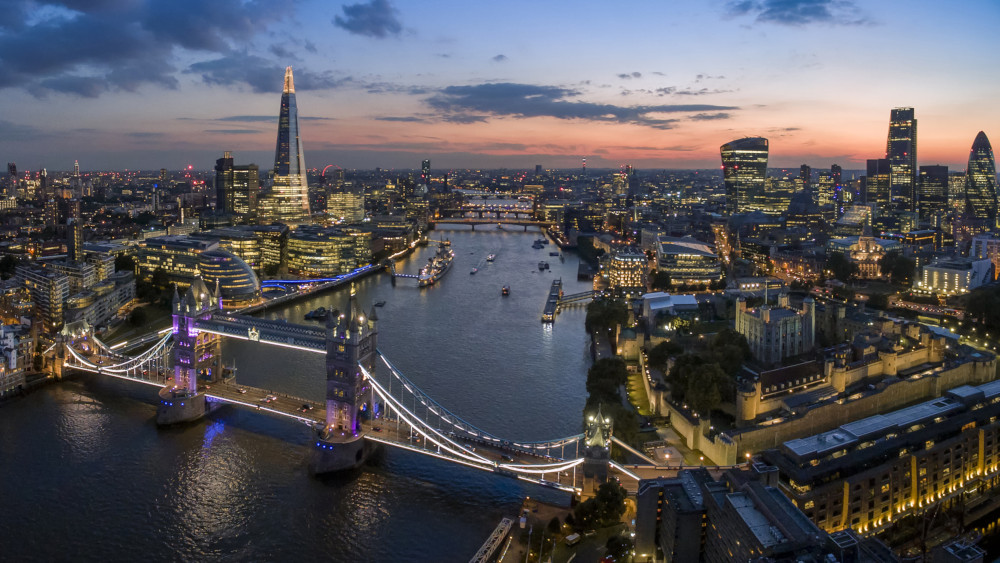
Thanks to the gracious hosting by Jane Street, we gathered a bit less than 20 people every day and managed to discuss and work on a large variety of subjects, including truly riveting discussions over the genetics of cross-breeding apples and oranges over lunch break.
The sprint was set in motion and organized by Pierre-Yves David and Raphaël Gomès, both maintainers of Mercurial working at Octobus, as well as Arun Kulshreshtha from Jane Street.
Day 1 - Wednesday 27th#
The first day saw everyone get started on tasks that they either had wanted to get done for a long time, or that sparked up from ad-hoc discussions. This was very much the point of this first day: a focus on bootstrapping occasional contributors and overall project maintenance.
If we include everything submitted during the 3-day window as far as visible changes go, we received a few bug fixes (#1965, #1968, #1969, #1970, #1971, #1976), some documentation (#1967, #1975, poulpe#82) and website improvements (hg-website#31), a new debug command (#1973) to create a synthetic repo from a DAG, and some good progress on larger work that never gets enough attention (#1974, #1966, ci-images#66). We also hatched a plan with Matt Harbison remoting in from the US to fix the Windows console encoding deprecation problem.
Progress was made on projects external to Mercurial but very much integral to its ecosystem. Manuel Jacob helped lay out a plan for hg-git's tech debt, while Georges Racinet handled Heptapod's 18.10.4 and 18.11.4 releases, while working towards making Heptapod "cloud native" by GitLab's definition (heptapod#1647).
Finally, for people who weren't busy with the above or getting familiar with new features of Mercurial, it was time to already start more high-level discussions. These discussions kept going for most of the rest of the sprint... which brings us to day 2 and 3!
Day 2 and 3 - Thursday 28th and Friday 29th#
The agenda for days 2 and 3 was to get everyone familiar with the latest, current and future developments of Mercurial, as well as to discuss concepts from the larger VCS ecosystem. Here are some of the larger discussions we can remember.
A Virtual File System for Mercurial#
As repositories grow larger and larger, filesystem overhead gets to be more and more
noticeable, both in terms of disk usage and speed. Even a fast Rust parallel
implementation of hg update can take up to several seconds for large working copies,
with kernel writes and inode creation overhead at the center of the slowdown.
It's no secret that tech giants like Microsoft or Meta have used virtual file systems to fight this scale and improve their developer experience, and it's time for Mercurial to grow its FOSS, fully integrated VFS.
Upstream development of this effort was started earlier this year. The first experimental read-only and local version based on FUSE is already being used by real users in conjunction with an overlay filesystem to support writes. This has improved the time to first interaction for a new working copy in the worst cases from 20s+ to under 2s, with only a 10-20% overhead in normal operations.
During the sprint, the discussions were mostly about planning what's next for the VFS:
faster update still, seamless support in hg status and hg update, and an integrated
write layer.
Heptapod, our friendly GitLab fork#
Heptapod is a major way that Mercurial stays relevant both for the FOSS community and professional users. Its maintainer Georges Racinet gave a small presentation about its current state and its future, right after being done keeping up with the latest GitLab releases.
This discussion helped clear a few misconceptions about Heptapod, fix a couple of small
user problems as well as helped with the hg-git effort. Finally, some of the blockers
for upgrading Heptapod to Mercurial 7.2 have been identified and will be dealt with soon.
Scaling obsmarker exchange and bundle caching#
Florian Horn, Laurent Bulteau and Pierre-Yves David presented and discussed with other attendees new developments that are currently being upstreamed. We have an upcoming set of algorithms and formats that enable significant performance and storage improvements for both exchanging obsolescence markers and improve the cache of bundles.
While the mathematical modelling has been underway for a long time, we have finally been able to start the upstream implementation and we will most likely cover that whole topic in a separate post when it becomes usable.
First-class conflicts#
As soon as you can do multiple things concurrently, you will have conflicts: they are an inevitable part of version control. A conflict is an ambiguity, and many version control systems give you neither a good model nor a good interface to help you with them.
Pijul (the spiritual successor to Darcs) is the only active version control system that we know of with a mathematical model of conflicts.
For our users, this model can be thought of as an extension of the Mercurial branching model: multiple heads on a branch is a natural consequence of things happening at the same time in a distributed branching model, conflicts are the natural consequence of things happening at the same time in a distributed version control system.
Why should we model file changes any differently than we do branches? It turns out that this model's contact with the real world is not without its share of headaches, and there are still a lot of things to iron out. Pierre-Étienne Meunier, creator and maintainer of Pijul, has been very open to collaboration.
Of course, lately the Jujutsu VCS has become very popular, with its own flavor of first-class conflicts. Some users seem to get a lot of mileage out of it and we can definitely learn something from the use cases it covers. Nevertheless, a more general and complete model is needed as there are edge cases were the approach suffers. Conflict handling turns out to be especially painful in the context of distributed safe mutable history, a central feature unique to Mercurial.
To that end, a lot of people gathered during the sprint to discuss how first-class conflicts can be brought to Mercurial, as well as other tools like Git or JJ. Caleb Owens from GitButler has already written down some of his thoughts in a small article!
The discussions covered many questions about how we can formally define some of the core concepts: what's a change? What's a merge? What's a conflict? What's the strength and weakness of each main models, merging state (Git, Mercurial, Jujustu) or merging patches (Pijul)? What could it actually mean to do a N way merge with multiple bases in the "state" model? Why is history rewriting (and rebase in particular) a challenge for the "patch" model?
Florian ended up re-inventing the Pijul model from first principles, who knew that different mathematicians could come up with the same ideas? While the couple of hours of discussion didn't magically produce perfect solutions, it helped the participants in sharing knowledge and get a fresh angle on the set of problems.
Normalized and composable history sharding#
Back in 2018, Google upstreamed their narrow extension, which allows for clones to
fetch a subset of the history of files. It has been put to good use but has always been
quite brittle without Google's infrastructure and required a lot of working around
problems.
During the 7.2 cycle, we started implementing a new model for this semi-centralized workflow: shapes. A shape is configured server-side, and is used to define a set of paths to consider for clients of the narrow server. And it does so through the entire history, regardless the state of these files in the heads of the repository (deleted, for example).
Here the advantages of store shapes over the old system::
We can define clonebundles for usual patterns
We can nest and generally compose includes and excludes
We can generate a fingerprint for equivalent patterns
We can require that the server and the client agree on patterns
Client are made aware of changes on the server, invalidating their patterns
A solid permissions system could be built on top of store shapes
Some legacy problems (e.g. CLI parsing) will be solved
This sprint helped crystalize the concepts and possibilities for a few users, some of whom seemed keen in sponsoring some of that work to benefit their corporate usage.
Evolution: safe mutable distributed history#
Mercurial's Changeset Evolution concept has been around for a while, and is the corner stone of how Mercurial is capable of safe and simple collaboration on draft history in a fully distributed setup.
At the sprint, Caleb Owens presented how GitButler approaches these collaboration problems, and how they are trying to extend Git's data model to track more information to supports these use-cases.
The current data model of Git creates some challenges: the content model is a CRDT, but unlike Mercurial the branching model isn't, so dealing with distributed changes affecting branches is complex. This has led Gitbutler to start with a rather centralized approach, with constrained synchronization phases. These clear synchronization barriers offer an opportunity to detect the intrinsic issues of distributed history edit and provide a UX to solve them. On the other hand, Mercurial's data model can represent a wider set of history editing information, all while retaining its full CDRT property. This can express a wider set of states without the need to solve theses issues at synchronization time. While we believe the richer model of Mercurial allows for more flexible and powerful workflows, GitButler's work on UX is quite interesting, and each approach has to learn from the other one.
Speaking of user experience, we also discussed the downsides of eagerly rebasing changesets during history edition, and how some rebases are not properly reversible, "silently" dropping some potentially crucial changes.
A wider round-table of changeset evolution users let them express what they liked and disliked about the current experience in Mercurial. Finally we discussed how to adapt GitLab's marge-bot for Heptapod: the result of this discussion has already been put in production somewhere, and the source should be made available soon.
Git compatibility (embrace, extend, extinguish)#
It is no secret that Git has won the popularity contest and currently sits at the very top of general-purpose usage for version control. There has existed tools to use Git repos in Mercurial and vice versa for a very long time now, but none of them are supported in the core of either VCS.
Caleb Owens representing the Git world and Raphaël Gomès representing the Mercurial world discussed the very real possibility of Mercurial becoming a great Git server, building on top of the many projects currently underway. This idea was floated around at the previous minisprint in Grenoble hosted by Pierre Augier, and has been a topic of discussion with Patrick Steinhardt for a few months now.
In more concrete terms, Mercurial's scaling capabilities coupled with the correct work could allow it to transparently speak Git's wire protocol and deliver unmatched performance for clones and fetches.
Separately, a Mercurial repository could easily expose a fake Git repository for simple use cases (IDEs, shell prompt, AI agents, etc.) using a similar VFS approach than the one detailed above.
Fixing the general problem of bi-directional Git support seems like it's not worth the work, but supporting 90% of use cases could already make Mercurial very relevant as a tool for the future of both client-side and server-side.
The Hyperlog, a new powerful storage format#
The revlog is the underlying storage format of all user data, and has been since the
beginning of the project. After a brief revlog-v0 period of 1 year, version 1 of the
revlog has been with us for more than 20 years now, scaling (surprisingly?) well to 10s
of millions of revisions and millions of files, partly thanks to very significant but
incremental improvements like generaldelta, zstd, sparserevlog, and many runtime
optimizations.
With all of this said, the format has been showing signs of weakness for a long time and
would be unable to truly usher us into the next jump in scale or user experience. We have
been working for a couple of years towards a new version of the revlog: V2, which we
nicknamed Hyperlog for the purpose of convincing management. while that name started
out as a joke, it feels perfectly corny and a worthy successor of RevlogNG, the
original name of V1.
Here is a non-exhaustive list of features that were discussed at the sprint:
Mutable index entries
Multiple index and data blocks/files for extensibility and memory locality
Sparse files with default values
Better transactionality
Unified filelogs, massively reducing the number of files on disk
There are huge scaling implications that come with this extensible of a format: truly first-class changeset evolution, correct and fast narrowing and widening, faster discovery, and generally many things that required a (usually brittle and somewhat slow) cache will now be part of an index, without penalizing the main index. This time, the format will also be sightly different for the changelog, manifestlog and filelogs.
Meta-recap#
Overall, the sprint was a success!
We made a lot of progress in different areas, and had people from multiple companies and projects highly involved the entire time, all within a fun atmosphere that kept going well after business hours.
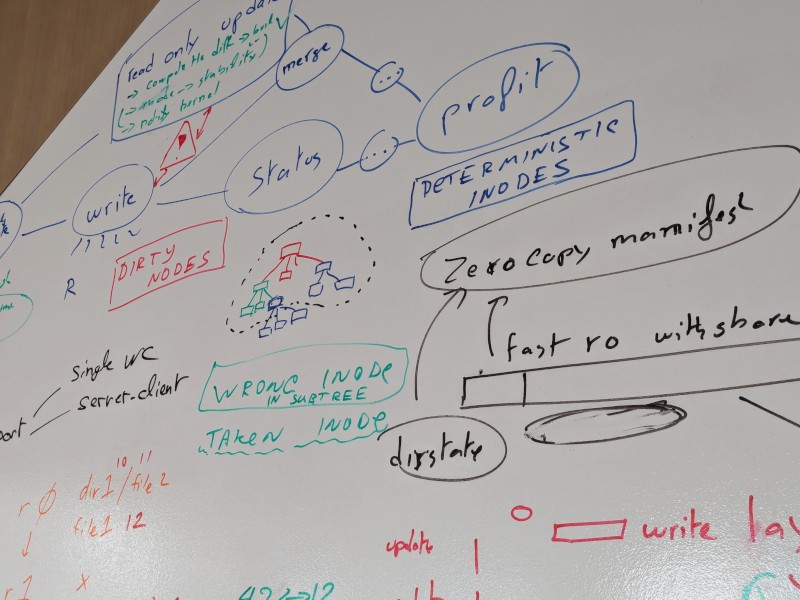
We were too busy to remember to take a picture of everyone, so we unfortunately only have a few pictures of whiteboards, as pictured:
We want to thank everyone that came out or otherwise participated, giving their precious time to help free and open-source version control move forward.
A few people were missing from last minute planning changes on their side, but we are hoping to see them (and more!) in the next edition of the sprint, which we are yet to start planning.